Your gas line feeds the appliances that keep you warm and supplied with hot water all winter. When it fails, the result is a cold house, a dead water heater, or a genuine safety emergency. Licensed gas fitters size, install, test, and repair the piping that carries natural gas or propane to every appliance in your home. Hiring the right one protects your family, your appliances, and your monthly energy bill.
At Plumber Service Boise, we handle gas piping every week across Boise, Meridian, Eagle, Nampa, and Caldwell. We often find gas problems during routine water heater installation and repair visits. Common culprits are an undersized line, a missing sediment trap, or a corroded fitting hiding behind the tank. This article explains what the work involves, how licensing works in Idaho, what it costs in 2026, and what to do the moment you smell gas.
Key Takeaways
- Hire licensed, permitted pros only. In Idaho, gas piping work requires a state license and a local mechanical permit, and every new line must pass a pressure test before use.
- Line sizing matters as much as leak-free fittings. An undersized line starves tankless water heaters, furnaces, and ranges. Boise’s elevation also changes how appliances burn.
- Smell rotten eggs? Leave first, call second. Get everyone outside, avoid light switches and phones indoors, and call 911 and Intermountain Gas from a safe distance.
What Gas Fitters Do (and How They Differ From General Plumbers)
Gas fitters install, repair, and test the fuel gas piping between your meter and your appliances. Water plumbing moves liquid under pressure. Gas piping moves a combustible vapor at much lower pressure, so the rules for sizing, joints, and testing are completely different. A small mistake on a water line causes a drip. A small mistake on a gas line can cause a fire.

Most residential systems run at about 7 inches of water column, roughly 0.25 psi. Some newer Treasure Valley homes use 2 psi systems with regulators near the appliances. Each setup needs different pipe sizing.
| Service | What It Involves | Typical Trigger |
|---|---|---|
| New gas line installation | Sizing, routing, and connecting pipe from meter or manifold to appliance | New range, dryer, fireplace, or water heater |
| Gas line extension | Adding a branch to existing piping | Remodel, outdoor kitchen, garage heater |
| Leak detection | Electronic sniffers, soap testing, and pressure decay tests | Odor, hissing, rising gas bill |
| Pressure testing | Isolating and pressurizing the system to confirm zero loss | Required after new work or repairs |
| Fuel conversion | Propane to natural gas, or electric to gas | New Intermountain Gas service at the street |
| Appliance hookup | Shut-off valve, sediment trap, flexible connector | Appliance replacement |
| Line replacement | Removing corroded or outdated pipe | Aging galvanized pipe, failed fittings |
Our plumbers frequently see this in older North End Boise homes: decades of add-ons, with a range, a dryer, and a fireplace all hung off a line originally sized for one furnace. The appliances “work,” but they underfire, soot up, and wear out early.
Start by listing every gas appliance you own today and every one you plan to add in the next five years. That list drives every sizing decision.
Check Also: How Plumbing Inspections in Boise Protect Your Home, Your Pipes, and Your Water Bill
Idaho Licensing: What a Gas Fitters License Means Here
Idaho licenses gas piping work through the state, not through individual cities. The Idaho Division of Occupational and Professional Licenses (DOPL) oversees the HVAC and plumbing trades, including gas-specific specialty licenses. Local jurisdictions such as the City of Boise, Meridian, and Ada County then issue the mechanical permits and send inspectors to verify the work.
The term “gas fitter” is a formal license title in some places. Massachusetts, for example, licenses gas fitters as a separate trade with its own exams and continuing education. In Idaho, a homeowner asking about a gas fitters license is really asking one question: does this contractor hold an active DOPL license that covers fuel gas piping?
| Credential or Requirement | Who Issues It | What It Covers |
|---|---|---|
| HVAC contractor / journeyman license | Idaho DOPL (HVAC Board) | Heating systems and associated fuel gas piping |
| Gas specialty licenses | Idaho DOPL | Limited-scope gas work, such as gas piping or hearth appliances |
| Plumbing contractor / journeyman license | Idaho DOPL (Plumbing Board) | Water, drain, and waste systems. Gas scope depends on licensing category |
| Mechanical permit | City or county building department | Required for new gas lines, extensions, and appliance installs |
| Final inspection | Local inspector | Verifies pressure test, materials, valves, and venting |
| Continuing education | Required for renewal | Keeps license holders current on code changes |
Idaho adopts the International Mechanical Code and the International Fuel Gas Code (IFGC). The IFGC sets the rules our crews follow on every job. Under that code, test pressure must be at least 1.5 times the working pressure and never less than 3 psig. The test must also hold for at least 10 minutes with zero pressure loss.
How to Verify a License in Under Five Minutes
- Ask for the license number. Any legitimate contractor gives it without hesitation.
- Search DOPL’s online license lookup. Confirm the license is active and covers the work you need.
- Confirm insurance. Ask for a certificate of liability insurance naming the company.
- Ask who pulls the permit. The contractor should pull it. A homeowner should never be asked to pull it for them.
- Request the final inspection sign-off. Keep it with your home records for resale and insurance.
Save the license number and permit number in the same folder as your appliance manuals.
Check Also: How Plumbers in Nampa Idaho Protect Your Home’s Pipes
How to Choose the Right Gas Pro in the Treasure Valley
The right contractor combines licensing, local permit experience, and clear pricing. Typing “gas fitters near me” into a search bar returns dozens of names. Licensing, permits, and testing habits separate the safe choices from the risky ones.

On recent service calls in Meridian, we’ve corrected work done by unlicensed handymen who used unapproved fittings and skipped the pressure test. The appliances lit. The joints still leaked. Lighting up on day one does not prove a line is safe.
Questions to Ask Before You Hire
- Will you calculate pipe sizing for my total appliance load, including future additions?
- Will you pull the mechanical permit and schedule the city inspection?
- What pressure test will you perform, and can I see the gauge?
- Will you install a shut-off valve and sediment trap at each appliance?
- If you use CSST, will you bond it to the electrical grounding system as code requires?
- Is your quote written and itemized, with permit fees listed separately?
Red Flags
- No license number offered, or a number that doesn’t appear in DOPL’s lookup
- “We don’t need a permit for this”
- Cash-only pricing with no written estimate
- No pressure test or a test that lasts only a minute or two
- Reusing old flex connectors on a new appliance
When you narrow down gas fitters in my area, favor companies that already work with Intermountain Gas and local inspectors. People searching “gas fitters Boise” often need a contractor who knows the City of Boise’s inspection process and the quirks of Bench-area and North End housing stock. That local knowledge makes jobs faster and inspections smoother.
Shortlist two or three licensed contractors and ask each one the six questions above.
10 Common Gas Line Problems We See in the Treasure Valley
Gas line problems fall into ten repeat categories. Some are slow and silent, like corrosion. Others are sudden and urgent, like damage from digging. This table shows how each one shows up and how we fix it.
| # | Problem | Common Cause | Warning Sign | Typical Fix |
|---|---|---|---|---|
| 1 | Gas leaks | Corroded pipe, loose fittings, poor install | Rotten egg odor, hissing | Locate, repair, pressure test |
| 2 | Corrosion and rust | Moisture, buried steel, aging pipe | Flaking or discolored pipe | Replace affected section |
| 3 | Blockages | Debris, pipe scale, insects in vents | Weak or uneven flame | Clear line, add sediment trap |
| 4 | Incorrect sizing | Added appliances without resizing | Appliances underfire or shut off | Upsize trunk or add dedicated line |
| 5 | Improper installation | Unlicensed work, wrong materials | Repeat leaks, failed inspection | Rework to code |
| 6 | Aging pipes | Galvanized steel, decades of wear | Frequent repairs | Partial or full repipe |
| 7 | Loose fittings | Vibration, poor tightening | Odor at joints | Reseal or replace fitting |
| 8 | High gas pressure | Faulty regulator | Large, roaring, or yellow flames | Replace regulator, call utility |
| 9 | Damaged pipes | Landscaping, fence posts, construction | Sudden supply loss, odor outdoors | Emergency repair, utility notice |
| 10 | “Frozen” lines | Iced regulator vents, moisture, propane in deep cold | Loss of supply in freezing weather | Clear vent, insulate, protect regulator |
What “Frozen Gas Lines” Really Means in Boise Winters
Natural gas itself does not freeze at Boise temperatures. The real winter failures happen around the line. Snow and ice can block a regulator vent, and moisture inside a line can freeze at low points. Propane tanks also lose pressure in deep cold. If you’ve dealt with frozen pipes in Idaho, the takeaway feels familiar: protect exposed components before January, not during it.
Check Also: Sewer Excavation Guide for Boise Homeowners: When to Dig, What It Costs, and How to Decide
Why Pipe Sizing Problems Are So Common Here
Treasure Valley homes keep getting upgrades. We see families add a tankless water heater, a gas range, and a patio fire pit without touching the original trunk line. Each appliance gets less gas when others run. The result is cold showers, error codes, and sooty burners.
Walk your home and note any appliance with a yellow flame, frequent ignition faults, or soot marks. Those are the first lines a licensed technician should check.
Gas Pipe Materials: Black Iron, CSST, and Polyethylene
Three materials handle almost every modern residential gas job. Each has a specific place in the system, and code controls where each one can go.
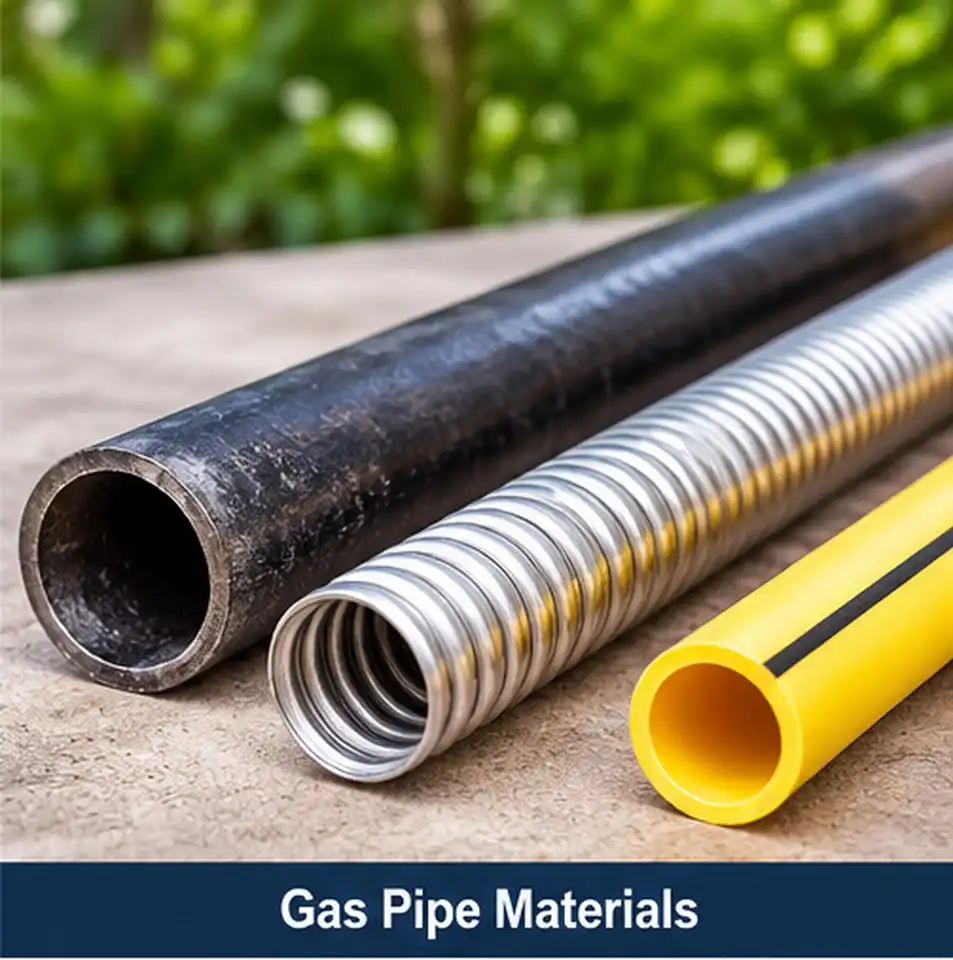
Your contractor’s material choices affect cost, installation time, and long-term durability.
| Material | Best Use | Typical Lifespan | Pros | Cons |
|---|---|---|---|---|
| Black iron (steel) | Indoor exposed runs, basements, mechanical rooms | 50+ years | Durable, impact-resistant, proven | Labor-heavy threading, corrodes if wet |
| CSST (corrugated stainless steel tubing) | Interior runs through walls, attics, crawlspaces | 30 to 50 years | Flexible, fewer joints, faster install | Must be bonded per code, vulnerable to nail damage |
| Polyethylene (PE) | Underground only, meter to house, outdoor features | 50+ years | Corrosion-proof, flexible in trenches | Never above ground, needs tracer wire |
| Galvanized steel (legacy) | Found in older homes, not recommended for gas | Varies | None for new work | Interior flaking can clog valves and orifices |
CSST Pros and Cons
Pros
- Fewer joints mean fewer potential leak points
- Faster installation in finished walls and tight attics
- Lower labor cost on long, winding runs
Cons
- Requires electrical bonding with a dedicated conductor to reduce lightning-related damage risk
- Needs strike plates where it passes through framing
- Not every handyman knows the manufacturer’s installation rules
Our plumbers often combine all three materials on one job. A typical Eagle outdoor kitchen project uses PE underground, black iron at the house wall, and CSST inside.
Ask any contractor which materials they plan to use and why. A clear answer is a strong sign of a well-planned job.
Gas Appliance Connections and BTU Demand
Every gas appliance needs a specific volume of fuel, measured in BTUs per hour. Your gas line must carry the combined load of every appliance that could run at the same time, at the full length of the run. Undersize it, and appliances underperform.
Oversize it badly, and you’ve paid for pipe you don’t need.
| Appliance | Typical Input (BTU/hr) | Common Supply Line Size | Notes |
|---|---|---|---|
| Tank water heater | 30,000 to 50,000 | 1/2″ | Needs sediment trap and proper venting |
| Tankless water heater | 150,000 to 199,000 | 3/4″ or larger | Most often undersized on retrofits |
| Furnace | 40,000 to 120,000 | 1/2″ to 3/4″ | Biggest winter load in most homes |
| Gas range | 40,000 to 65,000 | 1/2″ | Requires accessible shut-off |
| Clothes dryer | 20,000 to 35,000 | 1/2″ | Use new connector every install |
| Gas fireplace / insert | 20,000 to 40,000 | 1/2″ | Check venting and clearances |
| Built-in grill | 30,000 to 60,000 | 1/2″ | Outdoor shut-off recommended |
| Fire pit / fire table | 50,000 to 100,000+ | 1/2″ to 3/4″ | Long runs need upsizing |
| Standby generator | 100,000 to 300,000+ | 3/4″ to 1 1/4″ | May require meter upgrade |
Tankless units deserve special attention. A tankless heater can draw four to six times the gas of a standard tank. That’s why many of our tankless water heaters installs include a new dedicated line from the meter. The U.S. Department of Energy explains how on-demand units compare to storage tanks in its guide to tankless or demand-type water heaters. Efficiency gains only show up when the gas supply keeps pace.
How Boise’s Elevation Changes the Math
Boise sits about 2,700 feet above sea level. Air holds less oxygen at altitude, so appliances burn differently. The common industry practice is to derate appliance input by about 4% per 1,000 feet above sea level once you’re above 2,000 feet, unless the manufacturer specifies otherwise. A licensed installer checks the manufacturer’s high-altitude instructions, the orifice sizing, and the combustion readings before calling the job complete.
Before you buy a new gas appliance, send its spec sheet to your installer. They’ll confirm your existing line can handle it.
Cost Comparison: Gas Line Work in Boise (2026 Estimates)
Gas line pricing depends on distance, material, access, and permits. The ranges below reflect typical Treasure Valley residential jobs in 2026.

Final pricing always follows an on-site inspection. Treat these numbers as planning figures, not quotes.
| Job | Typical Cost Range | Time on Site | Permit Usually Required? |
|---|---|---|---|
| Gas range or dryer hookup (existing stub) | $150 – $400 | 1 to 2 hours | Varies by scope |
| New line to range or dryer | $300 – $900 | Half day | Yes |
| Gas line for tank water heater | $300 – $900 | Half day | Yes |
| Dedicated line for tankless water heater | $600 – $2,000 | 1 day | Yes |
| Fireplace or insert line | $400 – $1,200 | Half to full day | Yes |
| Outdoor grill or fire pit (trenched) | $800 – $3,000 | 1 to 2 days | Yes |
| Leak detection and repair | $200 – $800 | 1 to 4 hours | Repair-dependent |
| Pressure test only | $100 – $350 | 1 to 2 hours | No |
| Whole-home gas repipe | $3,000 – $10,000+ | 2 to 5 days | Yes |
| Mechanical permit fee | $50 – $250 | N/A | Local schedule |
What Drives Your Price Up or Down
- Run length: every extra foot adds material and labor
- Access: finished basements and tight crawlspaces add time
- Trenching: outdoor lines need 811 locates and backfill
- Pipe material: CSST often saves labor, black iron adds threading time
- Meter capacity: large loads may require a utility meter upgrade
- Code corrections: existing violations must be fixed before inspection
Comparing quotes from licensed gas fitters only works when each one covers the same scope. Ask every contractor to list pipe size, material, footage, and permit fees separately.
Repair vs. Replace: Making the Right Call
Repair fixes the failed point. Replacement fixes the system. The right choice depends on pipe age, material, and how often problems return.
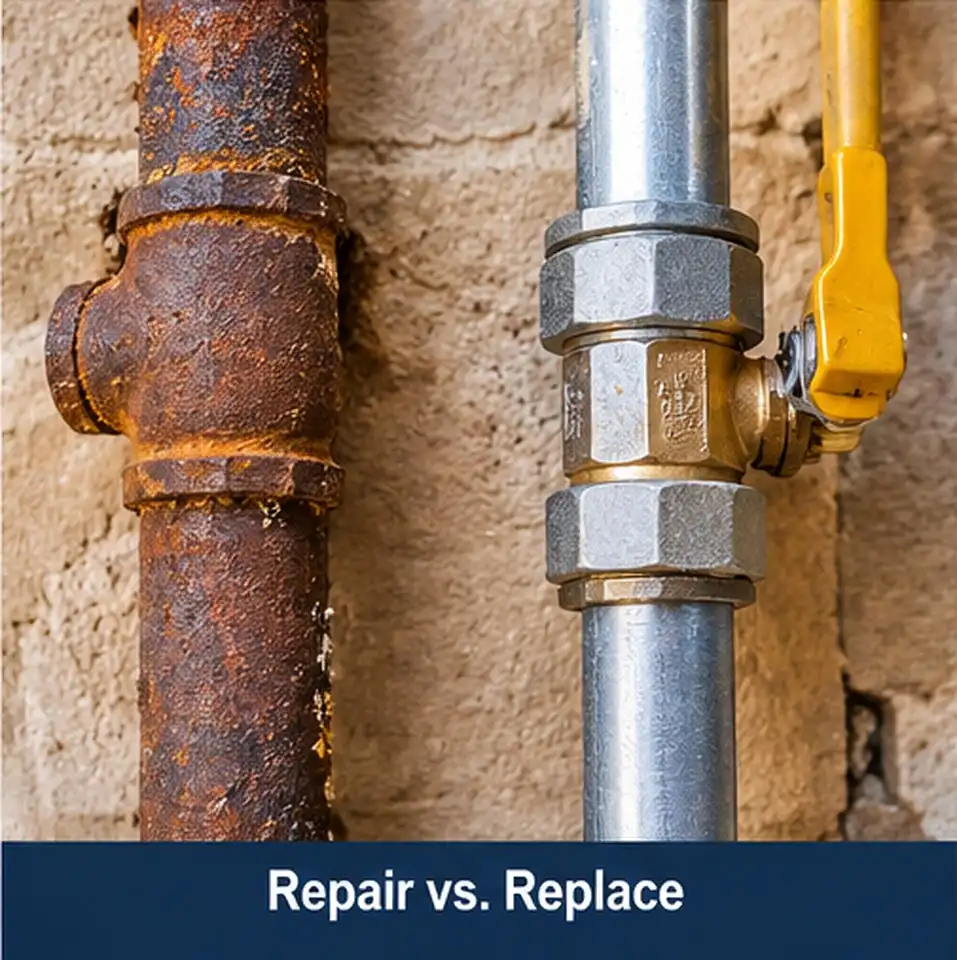
We give you both options in writing, with honest reasoning for each.
| Factor | Repair Makes Sense | Replacement Makes Sense |
|---|---|---|
| Pipe age | Under 30 years | 40+ years, or unknown |
| Material | Black iron, CSST, PE in good condition | Galvanized steel or mixed patchwork |
| Leak history | First leak, single fitting | Repeat leaks in different spots |
| Corrosion | Surface rust only | Pitting, flaking, or wall thinning |
| Capacity | Line handles current load | Adding tankless, generator, or outdoor kitchen |
| Inspection status | Passes test after fix | Multiple code violations |
| Typical cost | $200 – $800 | $1,500 – $10,000+ |
| Expected outcome | Restores safe operation | Resets system life by 30 to 50 years |
Older Boise neighborhoods built before the 1970s are where we most often recommend replacement. Newer subdivisions in Meridian and Kuna usually need targeted repairs or capacity upgrades instead.
If you’ve had two gas repairs in five years, ask for a full system evaluation before approving a third.
Safe Troubleshooting Steps Before You Call
Homeowners can safely check a few things before calling a pro. These steps never involve loosening fittings or opening gas connections.
If you smell gas at any point, stop and go straight to the emergency steps below.
- Check other appliances. If the range lights but the water heater won’t, the problem is likely the appliance, not the main supply.
- Look at the flame. A steady blue flame is normal. Yellow, orange, or lazy flames signal combustion problems.
- Check the meter area. Clear snow, ice, or debris from the regulator vent. Don’t touch the regulator itself.
- Confirm the shut-off valve. The handle should run parallel to the pipe when open.
- Review your gas bill. A sudden jump without a weather change can point to a leak or failing appliance.
- Test your CO alarms. Press the test button on every carbon monoxide detector.
If any check feels uncertain, stop and call a licensed technician.
Gas Leak Emergency Steps
A suspected gas leak requires immediate action. Natural gas has mercaptan added, which gives it a rotten egg smell. Trust that odor, even if it seems faint.
Speed matters more than diagnosis.
- Leave the house immediately. Get every person and pet outside. Leave doors open behind you.
- Avoid creating sparks. Don’t flip light switches, unplug appliances, use lighters, or start a car in an attached garage.
- Hold your call until you’re outside. Walk to a safe distance before using a cell phone.
- Call 911 and Intermountain Gas. Use the utility’s 24/7 emergency line listed on your bill.
- Shut off the meter only if it’s safe. Turn the valve a quarter turn so it sits crosswise to the pipe. Skip this step if the odor is strong near the meter.
- Stay out until cleared. Don’t re-enter until emergency responders or the utility say it’s safe.
- Schedule a licensed repair. After clearance, have a licensed pro find the source and perform a pressure test before gas is restored.
- Get checked if you feel symptoms. Headaches, dizziness, or nausea warrant medical attention.
Outdoor warning signs count too: dead grass in a strip over a buried line, bubbling in puddles, or hissing near the meter. A gas smell in the yard is still an emergency.
Post these steps inside a kitchen cabinet so everyone in your home can find them fast.
Annual Gas System Maintenance Checklist
Annual maintenance catches corrosion, loose fittings, and failing regulators before they become emergencies. We recommend scheduling it every fall, before Treasure Valley furnaces start running hard.

October and early November are ideal in Boise.
Homeowner Checklist (Monthly to Seasonal)
- Test all carbon monoxide detectors monthly
- Replace CO detector batteries twice a year
- Keep 3 feet of clearance around the gas meter
- Clear snow and ice from the meter and regulator vent after storms
- Watch appliance flames for yellow tips or soot
- Call 811 at least two business days before digging anywhere on your property
Professional Checklist (Annual)
- Leak test all accessible joints and connectors
- Inspect pipe for corrosion, rust, and physical damage
- Verify shut-off valves operate freely
- Check and clean sediment traps
- Confirm CSST bonding is intact
- Inspect flexible connectors for kinks, age, and wear
- Check venting on water heaters, furnaces, and fireplaces
- Measure combustion and CO output on major appliances
Seasonal Priorities
| Season | Focus | Why It Matters in Boise |
|---|---|---|
| Fall | Furnace and water heater gas checks | Heating loads peak from November to February |
| Winter | Meter and regulator vent clearing | Snow and ice can block vents |
| Spring | Outdoor line inspection | Thaw and landscaping expose damage |
| Summer | Grill and fire pit connections | Peak outdoor appliance use |
Put the fall inspection on your calendar now, before the heating rush fills appointment slots.
FAQs
Can I install or repair my own gas line in Idaho?
No. Gas line work in Idaho requires a licensed contractor and a mechanical permit. DIY work risks leaks, fire, and carbon monoxide exposure. It can also void insurance coverage and create problems at resale.
How long does a typical gas line installation take?
Most single-appliance lines take half a day to one day. Outdoor trenched lines and whole-home repipes take two to five days. Inspection scheduling may add a few days, depending on the city.
Do gas fitters handle water heater gas connections?
Yes. Connecting a gas water heater includes the shut-off valve, sediment trap, flex connector, and venting checks. Our team bundles that work into our full range of plumbing services, so one crew handles both the water side and the gas side.
How do I know if my gas line is undersized?
Watch for appliances that underfire when others run, error codes on tankless units, and yellow flames. A licensed pro calculates your total BTU load against pipe size and run length to confirm.
Is CSST safe?
Yes, when it’s installed and bonded to code. Bonding connects the tubing to your home’s electrical grounding system to reduce damage risk from lightning. Ask your installer to confirm bonding on every CSST job.
Will homeowners insurance cover gas line repairs?
Coverage depends on your policy and the cause. Many policies cover sudden, accidental damage but exclude wear and tear. We provide written documentation and photos to support your claim.
What should I do if my CO alarm goes off?
Get everyone outside right away and call 911. Don’t re-enter until responders clear the home. After that, schedule an inspection of every fuel-burning appliance. For after-hours problems like a failed water heater or a burst pipe, our emergency plumbing team answers 24/7.
Do I need a gas line upgrade to switch to tankless?
Often, yes. Most tankless units need 3/4″ supply lines or larger and up to 199,000 BTU/hr. Many older homes only have a 1/2″ line to the water heater location.
Final Thoughts: Treat Your Gas Line Like the Lifeline It Is
Your gas system works quietly until something goes wrong. Licensed gas fitters keep it safe, properly sized, and code-compliant. Proper permits, testing, and maintenance stretch the life of every furnace, range, and water heater you own.
We’ve spent more than a decade working on homes across Boise, Meridian, Eagle, Nampa, and Caldwell. That experience covers everything from North End retrofits to brand-new Kuna builds. We bring transparent pricing, clear explanations, and permitted work to every job. If you’re planning an upgrade, our tankless water heaters installs include a full gas supply check, so your new unit gets the fuel it needs from day one.
Call Plumber Service Boise at (888) 233-0019 to schedule a gas line inspection or request a free written estimate.